Why Phosphogypsum Can Be Used as a Filler in PP Corrugated Sheet
DATE:2026-10-13 14:07:27 / READ: / SOURCE:This station
Why Phosphogypsum Can Be Used as a Filler in PP Corrugated Sheet
The core reasons phosphogypsum can be used as a filler in PP Corrugated Sheet lie in its economic and environmental value of “turning waste into value” and the performance improvements achieved through modification technology. It is not simple physical blending, but a systematic engineering process involving chemical modification and process adaptation.
Cost Advantage: From “Waste Residue” to “Low-Cost Raw Material”
This is the most direct driving force. Phosphogypsum is an industrial solid waste from wet-process phosphoric acid production. For every ton of phosphoric acid produced, about 4–5 tons of phosphogypsum are generated. The raw material source is extremely abundant and its cost is very low.
- Raw material cost comparison: Traditional PP fillers, such as ground calcium carbonate, cost about RMB 500–600 per ton. In contrast, phosphogypsum, after purification, grinding, and other processing, has a comprehensive cost of only just over RMB 300 per ton.
- End-product cost: After adding phosphogypsum, the cost of packaging boxes made from PP Corrugated Sheet can be reduced from RMB 8,000–10,000 per ton for traditional PP plastic boxes to RMB 5,000–6,000 per ton. Reports show that with a new chemical modification process, the amount of polypropylene (PP) added can also be reduced by about 15%, further lowering the cost per ton by 10%–15%.
The main component of phosphogypsum is calcium sulfate (CaSO₄). Its surface is hydrophilic and oleophobic, making it naturally incompatible with oleophilic PP resin. Direct filling would prevent the PP Corrugated Sheet from forming or cause cracking. Therefore, surface modification is the key to achieving high filler loading.
- Modification principle: Through purification and calcination to prepare anhydrous or hemihydrate gypsum, and then through surface treatment with quaternary ammonium salts, stearic acid, or silane coupling agents such as KH570. These modifiers can “graft” onto the phosphogypsum surface, changing it from “hydrophilic” to “oleophilic and hydrophobic,” allowing it to bond tightly with the PP matrix.
- Achieving high filler loading: Well-modified phosphogypsum can achieve filler loadings as high as 65%, greatly replacing PP resin.
Performance: Mechanical Properties Comparable to or Even Better Than Traditional Fillers
Modified phosphogypsum as a filler is not only for cost reduction. There is solid research support for its improvement of PP composite performance.
- Mechanical property comparison: Studies show that under optimized process conditions, Type II anhydrous gypsum filler provides higher tensile strength and flexural modulus than traditional ground calcium carbonate, while its flexural strength and impact resistance are comparable to those of ground calcium carbonate. The addition of phosphogypsum can promote PP crystallization through heterogeneous nucleation, and through particle-induced “debonding and shear yielding” effects, it can increase the plastic deformation of the PP matrix, thereby improving the impact strength of the composite.
- End-product advantages: In actual production, packaging boxes made from phosphogypsum-filled PP Corrugated Sheet, at the same specifications, have 20%–30% higher compression performance than traditional cardboard boxes and 50%–60% higher tear resistance, while retaining the moisture-proof and durable characteristics of plastic boxes.
Environmental Value: Resource Utilization of Industrial Solid Waste
From a macro perspective, this technology provides a high-value-added utilization pathway for phosphogypsum, a major industrial solid waste. Traditionally, phosphogypsum has mainly been stockpiled, occupying land and posing environmental risks. Using it in PP Corrugated Sheet not only solves an environmental problem but also provides the plastics industry with a low-carbon, low-cost alternative filler, aligning with the direction of the circular economy.
About Wuhan Handern Machinery Co.,Ltd
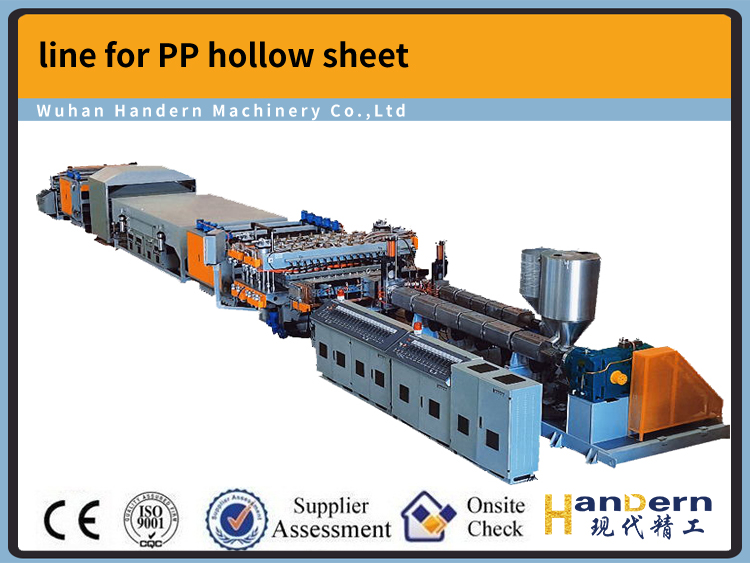
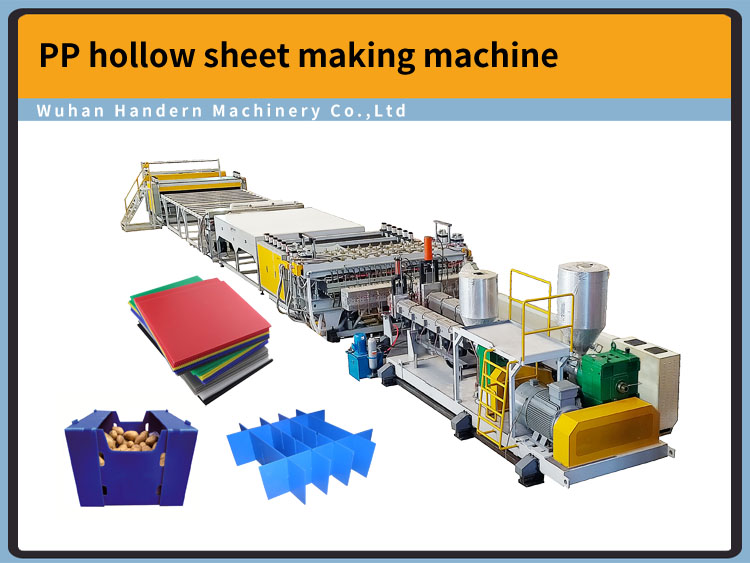
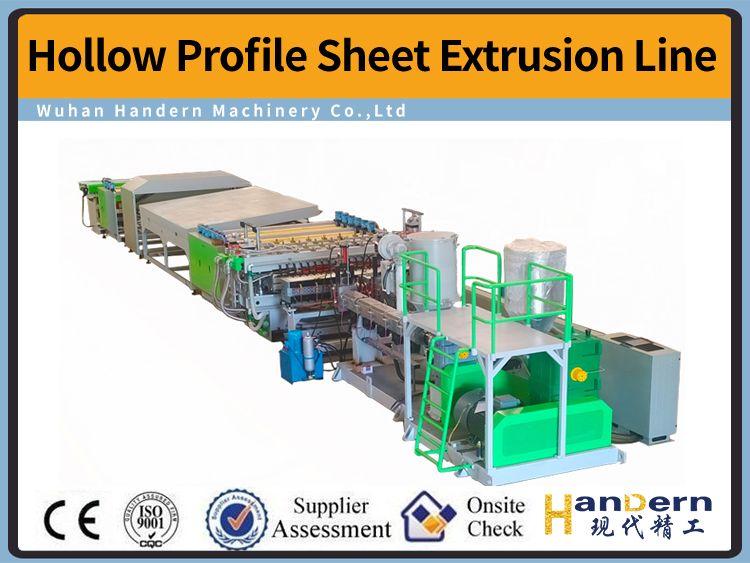
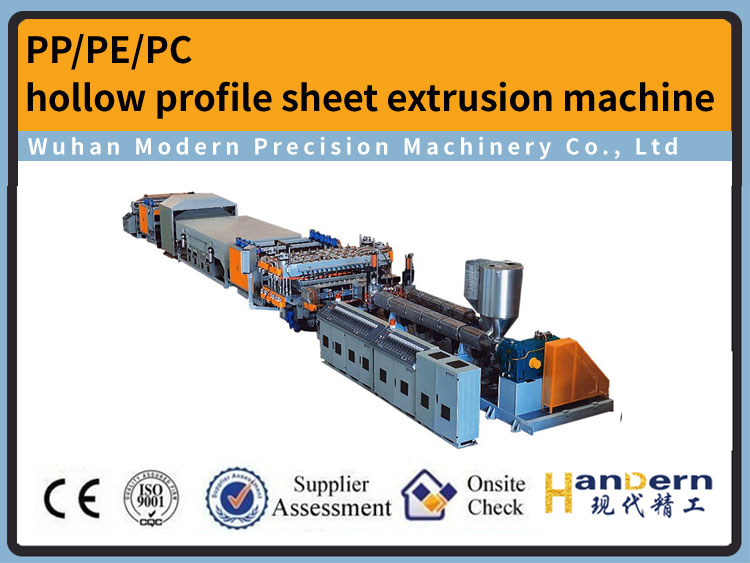
Wuhan Handern Machinery Co.,Ltd is a plastic machinery manufacturer with nearly 30 years of experience, specializing in the R&D and manufacturing of PP Corrugated Sheet Making Machine. The company has independently developed and mastered material formulations for PP Corrugated Sheet packaging boxes using multiple materials and specifications, including fly ash, phosphogypsum, calcium carbonate, waste plastics, and functional masterbatch. It can provide scientific and reasonable customized solutions according to customer needs and different application scenarios.
The core reasons phosphogypsum can be used as a filler in PP Corrugated Sheet lie in its economic and environmental value of “turning waste into value” and the performance improvements achieved through modification technology. It is not simple physical blending, but a systematic engineering process involving chemical modification and process adaptation.
Cost Advantage: From “Waste Residue” to “Low-Cost Raw Material”
This is the most direct driving force. Phosphogypsum is an industrial solid waste from wet-process phosphoric acid production. For every ton of phosphoric acid produced, about 4–5 tons of phosphogypsum are generated. The raw material source is extremely abundant and its cost is very low.
- Raw material cost comparison: Traditional PP fillers, such as ground calcium carbonate, cost about RMB 500–600 per ton. In contrast, phosphogypsum, after purification, grinding, and other processing, has a comprehensive cost of only just over RMB 300 per ton.
- End-product cost: After adding phosphogypsum, the cost of packaging boxes made from PP Corrugated Sheet can be reduced from RMB 8,000–10,000 per ton for traditional PP plastic boxes to RMB 5,000–6,000 per ton. Reports show that with a new chemical modification process, the amount of polypropylene (PP) added can also be reduced by about 15%, further lowering the cost per ton by 10%–15%.


The main component of phosphogypsum is calcium sulfate (CaSO₄). Its surface is hydrophilic and oleophobic, making it naturally incompatible with oleophilic PP resin. Direct filling would prevent the PP Corrugated Sheet from forming or cause cracking. Therefore, surface modification is the key to achieving high filler loading.
- Modification principle: Through purification and calcination to prepare anhydrous or hemihydrate gypsum, and then through surface treatment with quaternary ammonium salts, stearic acid, or silane coupling agents such as KH570. These modifiers can “graft” onto the phosphogypsum surface, changing it from “hydrophilic” to “oleophilic and hydrophobic,” allowing it to bond tightly with the PP matrix.
- Achieving high filler loading: Well-modified phosphogypsum can achieve filler loadings as high as 65%, greatly replacing PP resin.
Performance: Mechanical Properties Comparable to or Even Better Than Traditional Fillers
Modified phosphogypsum as a filler is not only for cost reduction. There is solid research support for its improvement of PP composite performance.
- Mechanical property comparison: Studies show that under optimized process conditions, Type II anhydrous gypsum filler provides higher tensile strength and flexural modulus than traditional ground calcium carbonate, while its flexural strength and impact resistance are comparable to those of ground calcium carbonate. The addition of phosphogypsum can promote PP crystallization through heterogeneous nucleation, and through particle-induced “debonding and shear yielding” effects, it can increase the plastic deformation of the PP matrix, thereby improving the impact strength of the composite.
- End-product advantages: In actual production, packaging boxes made from phosphogypsum-filled PP Corrugated Sheet, at the same specifications, have 20%–30% higher compression performance than traditional cardboard boxes and 50%–60% higher tear resistance, while retaining the moisture-proof and durable characteristics of plastic boxes.
Environmental Value: Resource Utilization of Industrial Solid Waste
From a macro perspective, this technology provides a high-value-added utilization pathway for phosphogypsum, a major industrial solid waste. Traditionally, phosphogypsum has mainly been stockpiled, occupying land and posing environmental risks. Using it in PP Corrugated Sheet not only solves an environmental problem but also provides the plastics industry with a low-carbon, low-cost alternative filler, aligning with the direction of the circular economy.
In summary, phosphogypsum can become a filler for PP Corrugated Sheet because of the combined effects of economic viability (low cost), technical feasibility (surface modification), and product performance (mechanical reinforcement). It successfully transforms an environmental “burden” into an industrial raw material with market competitiveness.

About Wuhan Handern Machinery Co.,Ltd
Wuhan Handern Machinery Co.,Ltd is a plastic machinery manufacturer with nearly 30 years of experience, specializing in the R&D and manufacturing of PP Corrugated Sheet Making Machine. The company has independently developed and mastered material formulations for PP Corrugated Sheet packaging boxes using multiple materials and specifications, including fly ash, phosphogypsum, calcium carbonate, waste plastics, and functional masterbatch. It can provide scientific and reasonable customized solutions according to customer needs and different application scenarios.
Author:admin